Gadgets Market 24: best smartphone
Showing posts with label best smartphone. Show all posts

Monday, February 12, 2018

Smartphone Cases Best clear cases for Galaxy Note 8
5:23 AM0 Comments
Today we’re going to look at some of the best clear cases for the newly announced Winter Olympics edition of the Galaxy Note 8. This limited edition phone will be given to each athlete at the 2018 Winter Olympics in PyeongChang, and may go on sale later this year. Even if you don’t have this phone, we’re sure you’ll enjoy our full range of clear Note 8 cases and covers!

1. Olixar Ultra-Thin Case – 100% Clear


The Olixar Ultra-Thin Case is an excellent budget choice when it comes to clear Note 8 cases. The case is made from a thin gel material, making it flexible and easy to apply. The same material also means that the case is easy to grip, preventing you from accidentally dropping your phone. The case is also available in other shades, if you’d prefer to give your Note 8 a different tint.

Today's Deal           Buy From Amazon

2. Ghostek Cloak 3 Tough Case – Clear / Silver


This shock-resistant case is ideal for anyone that’s a little bit harder on their phone. The Cloak uses a metallic frame to add rigidity and style in equal measure, while the raised bezel keeps the screen safe while the Note 8 is face-down. The case also uses both hard polycarboante and clear TPU, providing a ton of protection in a very small space. If you want a high-end protective case that’s still clear as the winter sky, this is a great choice.

Today's Deal               Buy From Amazon

3. Olixar ExoShield Tough Snap-on Case – Clear


Our second Olixar case in this roundup, the ExoShield is a stronger and more protective alternative to the Ultra-Thin case. The case’s reinforced corners allow it to survive the wear and tear of everyday use, while the non-slip coating helps to prevent accidental drops. Despite its protective credentials, the EoxShield remains a slip case that doesn’t add significant bulk to your Note 8.

Today's Deal          Buy From Amazon

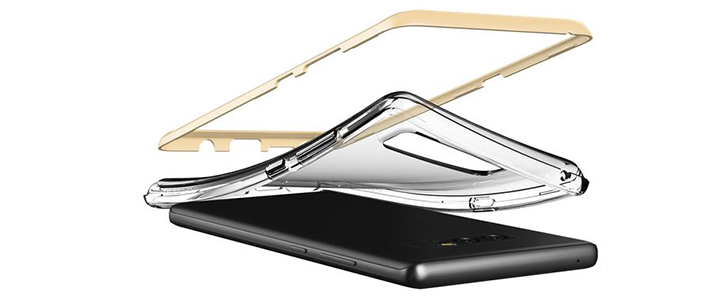
4. VRS Design Crystal Bumper – Shine Gold


The Crystal Bumper is one of the most stylish clear cases we have for the Galaxy Note 8. The case adds a slim bumper to the Note 8, protecting it from drops and preventing the screen from getting scratched while leaving the front and back fully accessible. This is the best way to show off the intricate design of the Note 8 Winter Olympics Edition, or just the colour you’ve chosen for the regular Note 8. The case is available in a range of colours, but we love the Shine Gold version shown above.

Today's Deal           Buy From Amazon

5. Rearth Ringke Fusion – Clear


Our final recommended clear case for the Galaxy Note 8 is a great all-around choice, offering a good split between protection, style and size. The Rearth Ringke Fusion uses an efficient dual-layer design, combining soft TPU and harder polycarbonate in a single package. The case includes cutouts wherever necessary, without adding needless ornamentation. Instead, the star of the show is your Note 8, just as it should be. If you’re not sure which clear Galaxy Note 8 case to choose, we recommend you start with the Rearth Ringke Fusion!

Today's Deal             Buy From Amazon


Reading Time:

Sunday, February 11, 2018

Best Smartphone LG G6 review: A return to form
11:18 AM0 Comments
After years of chasing gimmicks, LG decides to just make a good phone.
Today's Deal              Buy From Amazon

The quick take

The quick take: LG achieves its goal of packing a balanced, powerful Android experience into a more hand-friendly form factor. But it remains to be seen whether the G6 is a true "flagship" to compete with the upcoming Galaxy S8. The LG G6's success (or otherwise) will depend on its price tag, and how the competition measures up.

LG G6 Full Review

"No gimmicks" is this year's LG gimmick.
For the past several launch cycles, it seemed like LG needed to have some eye-catching new thing to attract attention to its phones — a single crutch which would, hopefully, make consumers care about its G-series handsets over Samsung's dominant Galaxy range. Recent efforts have included shiny shiny crystals, notification tones from singing schoolboys, lasers!, cow parts glued to the back and bad modular accessories.
Sure, we can make fun of the LG Rolling Bot and the Vienna boys' choir, but the ideas weren't universally awful. The real problem was that LG, in the past three years, seemingly hadn't progressed much further than the old metaphor of throwing shit at a wall. Some of it has stuck — features like dual cameras, OIS, laser autofocus and super-sharp displays have become staples of the modern Android flagship. Others, like buttons on the back, haven't made the cut.
And it's no surprise that in 2017 we're adding the LG G5's ill-conceived modular system to that conceptual dumpster.
Perhaps the G6's 18:9 2:1-aspect ratio screen is just this year's LG thing, to be discarded in another 12 months or so in favor of the next thing. But after a few days of using the phone ahead of its MWC 2017 unveiling, I'd argue that it's more than mere gimmickry. There's a solid, if slightly understated phone built around this lanky display, and LG's attitude with its latest handset is less "look at this crazy thing we did" and more "look at our cool new phone."
At the same time, the company isn't targeting spec hounds with 2017's G-series phone, which isn't an enormous leap beyond the V20 in raw horsepower, and actually lacks a couple of that phone's major features. (All part of an effort to better differentiate the G and V lines, LG tells me.) I'd hope to see that reflected in the eventual price point, which I don't yet know at the time of writing.
Anyway, is this new, gimmick-free LG phone actually any good? It's time to find out.

About this review

We're republishing this review after using the phone for just over a month. I (Alex Dobie) have been carrying the unlocked model (LGUS997) on firmware v09l, with the March 1, 2017 Android Security Patch, based on Android 7.0 Nougat. The phone was updated to v10a during the review period. I've been using the phone in Manchester and London, England, as well as Barcelona, Spain during MWC 2017. Prior to reviewing the phone, I spent a few days in Seoul, South Korea, where I was able to use a number of pre-production G6 models.

LG G6 Hardware

At first glance, the LG G6 is both familiar and something of an oddball. For a 5.7-inch phone, it's smaller than you'd expect. There's an entirely obvious reason for that — for a modern smartphone of any kind, the screen is a good deal taller than any previous model. And while the curved glass back panel has echoes of Samsung's Galaxy line, the front is almost aggressively flat, with a chamfered metal trim that's essentially flush with the display.
That's a deliberate design decision, LG tells us, with the idea being to avoid exposed "2.5D" glass protrusions on the front, which would be a structural weakness should the phone take a tumble. (You'll still need to deal with curved glass on the back, however that panel is furnished in Gorilla Glass 5, as opposed to version 3 of the material, which makes up the screen.) The front face has an unconventional look, but it's also a welcome respite from the sea of phones with slightly curved glass displays.
This is a phone which feels both big and small at the same time, and the form factor is just a tad reminiscent of traditional candybars like LG's own Chocolate phones of yesteryear. Of course there is an argument to be had about just how useful a 5.7-inch, 18:9 display is, given that most videos, shot at 16:9, conjure up black borders on the G6. But for the most part, Android apps fill the extra space without issue.
The G6 is crafted from metal and glass, and now the battery is fully sealed in, so you won't be popping off the back to swap power packs — or, for any other reason. As a result, this thing feels solid and well-built, with clean lines, precise joins and a pleasing contrast between the deliberately flat front face and the more ergonomic curved rear. This isn't a rugged phone by any means, but it feels much more sturdy than anything LG has produced before. Your three color options are black, white and "platinum" — my personal favorite — the back of which has a neat brushed texture beneath the glass.
(In meetings in Seoul, Korea ahead of today's launch, LG hinted that more G6 colors would likely be arriving sometime after launch.)

The solid outer frame holding everything together has a pleasant brushed texture, and the chamfers on either side help with gripability. These side walls aren't as intentionally slim as many of Samsung's recent phones — the G6 wears its 7.9mm thickness on its sleeve. But again, there's something reassuring about a phone which doesn't try to chase numbers like this.
No matter how much you baby it, the back of the G6 is going to pick up scratches.
While the G6 may feel like a well-built, premium smartphone, it's worth pointing out that like every other device with a flush glass back, the rear of this thing is inevitably going to accumulate scratches. I've already picked up one particularly gnarly one right in the center of my G6's back panel after just a few days of use. (At least it has no trouble staying still while laying on a flat surface, unlike, say, the notoriously slippery Honor 8).
Other hardware staples include IP68-rated water and dust resistance, meaning you don't need to worry about your G6 getting drenched out in a rainstorm, or rinsing it off if it ends up on the wrong end of a spilled beverage.

Operating SystemAndroid 7.0 Nougat
Display5.7-inch LCD 
2880x1440
Gorilla Glass 3
Dolby Vision, HDR10
ProcessorQualcomm Snapdragon 821 (MSM8996)
Storage32GB (U.S., Europe)
64GB (Asia, Korea, Hong Kong, India, CiS)
ExpandablemicroSD up to 2TB
RAM4GB
Camera (Main)13MP (IMX258), 1.12µm pixels, f/1.8, OIS
71-degree lens, phase-detect AF
Camera (Wide)13MP (IMX258), 1.12µm pixels, f/2.4
125-degree lens, fixed focus
Front Camera5MP, f/2.2
100-degree lens
ConnectivityWi-Fi 802.11ac, Bluetooth 4.2 LE, NFC
USB-C 3.1
Audio32-bit Hi-Fi Quad DAC (Asia only)
Battery3300mAh
Non-removable
ChargingUSB-C
Quick Charge 3.0
Qi wireless (U.S.)
Water resistanceIP68
SecurityOne-touch fingerprint sensor
Dimensions148.9 x 71.9 x 7.9 mm
ColorsBlack, white, platinum
And on the inside, there's a dependable assortment of high-end, early-2017 specs. At its core, the G6 is powered by a Qualcomm Snapdragon 821 (not the upcoming 835, which won't be around for another couple of months), backed up by 4GB of RAM. The base model, somewhat disappointingly, only comes with 32GB of storage, though that's offset by the microSD slot, to which heavier content can be offloaded. (System data, in case you were wondering, takes up a whopping 11GB on my U.S. unlocked G6.)

Some of the G6's other tentpole features have weird geographic restrictions. The Quad DAC — an upgraded version of the audio feature from the V20 — is only available in Korea and a handful of other Asian markets. And wireless charging is exclusive to the U.S., so other regions will have to make do with good old-fashioned cable charging over Qualcomm Quick Charge 3. And if you want a 64 GB G6, that's also restricted to parts of Asia and Eastern Europe.
For everyone else, it's 32GB, no Quad DAC and no wireless charging, which seems unnecessarily stingy given that few other manufacturers split up features like this. (It also means there's no single G6 model with all these features.)
A phone's display is always one of the most important hardware characteristics, and that's especially true of the G6's extra-tall screen. It's a 5.7-inch IPS LCD at 2880x1440 resolution (think Quad HD with an extra 300 pixels or so stacked on the top), and it looks great. After all the well-documented issues with the G5's disappointingly, dark, weirdly green panel, it's fantastic to see this return to form in the G6. LG claims the panel can reach over 600 nits in brightness to stay clearly visible under sunlight, and that matches my experience using the phone for a few sunny days out in Barcelona.
The display is also Dolby Vision and HDR10-ready, and LG told us the phone would "just work" when HDR content starts to hit the mobile versions of streaming platforms like Netflix. We don't have any specifics on exactly how that'll work, though.

The speaker setup is more run-of-the-mill. There's a single, bottom-firing can that'll get reasonably loud, but without the bass and clarity of rivals like the iPhone, HTC 10 and Huawei Mate 9. It's decent, but nothing to write home about.
LG's dual camera system returns, this time with 13-megapixel sensors in both rear shooters — the 71-degree standard camera and the 125-degree wide-angle. Around the back, you get both standard and wide-angle shooters at 13 megapixels, this time using the same sensor. There are some differences in terms of the optics though. The standard camera has a bright f/1.8 lens and optical stabilization, on the wide angle it's f/2.4 without OIS. So, predictably, the wide-angle camera doesn't perform quite as well in low light. We'll dig deeper on this in later in our review.
A lot of fuss has been made about the fact that the G6 is technically launching with last year's processor, and that it's stepping down from 13 megapixels in its main camera. Yet while it remains to be seen how the G6 will measure up next to the wave of new phones expected to arrive in the months ahead, I'm largely OK with the hardware on offer here, both on the inside and the outside.

LG G6 Software

It's easy to look at the software on the LG G6 G6 next to an V20 (or even a year-old G5) and say that not a whole lot has changed. And you wouldn't be entirely wrong in saying that. The color palette, rounded rectangular icon style and lack-of-an-app-drawer by default have held over from the previous generation. However the fact that LG hasn't completely scrapped its software design and started over is a good thing. Instead of a completely different visual style, LG has cleaned things up across the board, to produce a UI that looks like an evolution of last year's software efforts.
LG's latest interface is built upon Android 7.0 Nougat — unfortunately not the newer 7.1.1 Nougat right this second, but LG tells us the G6 will indeed launch on 7.1 in when it comes to the U.S. (In Korea, you'll get the 7.0-based firmware we've been using for the past few days.)
The new 2:1 display lets LG crank up the information density and introduce some interesting new software features to take advantage of its lanky proportions. That taller display lets LG split many of its own apps — like Contacts, Music and Calendar — into two (mostly) equal square sections, with rich visuals up top and extra room for information down below. And obviously a taller screen is great for multi-window too, allowing you to see more of each individual app.
LG's flirtation with "squircles" — rounded rectangular bubbles for each of its app icons — continues in its latest software, giving both first-party and third-party apps a rectangular border for added visual consistency. Although if you're not a fan, these can be easily changed in the home screen settings panel.
The rest of the software builds on the work LG started last year with the G5 and V20, making things a bit more visually consistent throughout, and settling on a refreshed design language with lighter colors, plenty of rounded rectangles and geometric graphics that fit with Google's Material Design language. LG's color scheme is vivid, but not obnoxious, and the company has taken a leaf out of Google's book with wallpapers based upon layers of colored card, and abstract graphics in apps like Weather and Clock.
The company has also built out a range of themes to complement each of the G6's colors, with icons and wallpapers to match the outer hues of each model. Some of these look pretty jarring, however, so I've stuck to the default theme on my device.
LG UX 6.0 is an evolution of what we saw on the V20 last year, with some neat design tweaks suited to the taller 2:1 display.
Other LG staples like KnockOn (double-tap to wake) are back, and extra-useful because the power key and fingerprint sensor live around the back. However if you were hoping LG would mimic the Pixel's swipe-down shortcut on the fingerprint scanner for quick notification shade access, you'll be disappointed — the gesture isn't enabled on the G6. That's a shame, because this kind of gesture shortcut would be amazingly useful on such a tall device, where reaching the top of the screen can be challenging. You can at least conjure up a notification shortcut button in the nav bar down below.
All in all, I'm pleased with the software tweaks LG has made here, though Android purists may view it as a little too customized.
It's just unfortunate that few third-party applications are likely to take advantage of the new, taller screen in the same way LG's own apps do. (That may change when more devices adopt this taller aspect ratio.) And obviously an 18:9 screen will leave you with unsightly black bars on the sides when you're watching standard 16:9 videos, giving you a significantly smaller viewable area than the 16:9 diagonal of the physical display.
Meanwhile, the rounded corners of the screen, while they're a neat design touch, annoyingly don't quite match up with the corners of the bezel — it's a minor thing, but something you can never un-see. (Your screenshots, for what it's worth, have plain old squared-off corners.)
The LG G6 also has the honor of being the first non-Google phone to ship with Google Assistant, the same Google-powered AI that first arrived on the Pixel to mixed feedback. Assistant on the Pixel is useful, but not quite the killer app Google has promised, though it has been improving significantly in the four months or so since launch. There isn't anything particularly special about the G6's implementation of Assistant, it looks and works exactly like it does on Google's handsets, allowing you to ask questions directly to Google, and receive spoken answers back based on the knowledge graph, and the information in your Google account.
As on the Pixel, there are instances where Assistant can startle you with its wisdom — like correctly identifying a building based on your description. Other features, like the ability to recognize songs (something built into the regular Google app on Android), are oddly still not there.

LG G6 Cameras

The G6's dual camera setup is sure to be one of the more controversial hardware decisions, because on paper it seems like the phone takes a small but noteworthy downgrade (or at best a sidegrade) compared to its immediate predecessor.
Whereas the G5 has a 16-megapixel main camera backed up by an 8-megapixel wide-angle lens, the G6 has two 13-megapixel shooters — one wide-angle camera at 125 degrees, with an f/2.4 lens, the other an f/1.8 lens, optically stabilized, at a more traditional 71 degrees. For what it's worth, we're not talking about any kind of fancy 1.4 or 1.5-micron pixel sensors, like Google's Pixel and Samsung's GS7. You've got plain old 1.12-micron pixels at play, which usually wouldn't bode well for low light performance.
So there's parity in terms of megapixel count between both cameras, but because of the disparity in optics, you'd expect the wide angle camera to come out a little worse in low light performance.
So how does real-world performance measure up?
On paper the G6's main sensor doesn't appear to be anything special. Yet the overall package, with that bright lens and OIS, beats the Galaxy S7 and goes toe-to-toe with the Google Pixel in the dark, thanks in part to LG's software tuning. And although wide angle camera can become grainy in darker conditions, it's miles ahead of the old 8-megapixel sensor from the V20 and G5. With a steady hand (and sometimes, the assistance of LG's great manual shooting modes), it's possible to get some fantastic wide-angle shots.
And in daylight, the results can be truly spectacular, with rich colors complementing the broad field of view.
I was ready to be underwhelmed by the G6's cameras, just based on the numbers, and instead I've been very pleasantly surprised. This is a fantastic camera setup, with fine detail performance to rival some of the best out there, great dynamic range and punchy, but not unnatural colors. It's also been great to get reacquainted with the 125-degree wide-angle camera — a feature I loved in the G5, but soon had to leave behind because the rest of that phone was so disappointing. It's true that the difference in optics reduces fine detail capture in wide-angle shots, but still, being able to just push a button and capture a really wide field of vision is incredibly fun.
Some of my fellow Mobile Nations editors have been eyeing the G6's wide-angle camera with envy, and I suspect for many phone buyers in the coming months this feature might be what sells them on the G6.
It's also important to note that low-light performance from the G6 — at least from its main sensor — far outperforms what I had expected based on the specs. I think the Google Pixel still captures slightly better color detail, but when it comes fine detail performance, the advantage is LG's.
Around the front, there's a 5-megapixel, 100-degree sensor that can switch between a cropped-in view and a wider angle to fit in your friends, a bit of extra scenery, or both. Low-light performance on the front-facer isn't great, especially in video mode, but it's perfectly fine for sharing on your phone, via Facebook or whatever else. And as you'd expect, performance improved rapidly with decent indoor lighting, or in daylit shots.
The G6's rear shooters make for a much more capable video camera, with software stabilization features that you may remember from the V20. As usual, the regular camera does a bit better in the dark compared to the wide-angle. And at a normal walking pace, LG's stabilization does a good job of smoothing stuff out, with only minimal ghosting in tougher lighting conditions. I'd still say the Google Pixel's video stabilization is better overall, but it is pretty close, with the biggest difference being more noticeable blurring around lighter areas within darker shots.
As with still photography, the most fun aspect of shooting video with the G6 is seeing just how much detail you can suck in with the wide-angle lens, giving you a more immersive view into the subject of your footage.
On the software side, LG has also expanded its camera app to take advantage of the new 2:1 aspect ratio, with a useful filmstrip view giving showing you your last few photos alongside the viewfinder. Some shooting modes have been rearranged too, with the HDR toggle (confusingly) now living behind a menu overflow. Instead, LG gives top-level exposure to panoramas, 360 pano and slow-mo modes.
Once again, photography might be the main reason to choose an LG phone this year. However good the Galaxy S8's camera is, it's basically guaranteed to lack the G6's wide-angle chops. And the fact that it outperforms expectations in darker shots bodes well for its competitiveness against what's coming later in the year.

LG G6 Battery Life

The move away from removable batteries gives LG the chance to fit a slightly beefier cell in its new high-end offering. And that's exactly what it's done, with an ample (but not numerically outstanding) 3,300mAh internal battery keeping the G6 chugging along. And you'll be able to rapidly juice it up using Qualcomm's Quick Charge 3.0, just like the G5.
Americans also get wireless charging support to boast about, a feature sadly exclusive to the United States. Given that Samsung has been offering wireless charging as standard for almost two years, it seems crazy for LG to limit this functionality to specific regions.
3,300mAh isn't an enormous amount of juice for a 5.7-inch phone, but the G6 manages just fine regardless.
3,300mAh gets you a full day, but not much more.
I've found the integrated power pack to be good for a solid day's use out here in Barcelona, even over the course of a few busy days getting ready for Mobile World Congress 2017. Bouncing between LTE and Wifi, and taking a couple of hundred photos each day, I found I'd take the G6 off its charger at around 8am and start running out of juice again around 10pm. That said, making extensive use of the cameras can quickly drain the G6 into the danger zone. On a couple of heavier days when I was taking lots of video as well as still images, I hit the 15 percent warning level by 6pm in the evening.
That's pretty much standard for a high-end Android phone right now — a full day's use, but probably not much more than that, and extra power suck from using demanding features. Naturally, should you need a mid-day refresh, Qualcomm Quick Charge 3 has you covered.
Since we've been using the LG G6 with pre-production firmware, we'll update this review when we're on final G6 firmware to note any differences, as well as any changes — good or bad — in battery performance over time.

Should you buy the LG G6? Yes

When I look back on many of the gimmicks LG has tried to use to sell smartphones over the years, the most striking thing about the G6 is how this time the focus is on just making a good, balanced phone that does most thing really well, and a few things. As much as you could argue that the taller display is indeed a gimmick, LG's doing enough with it that it's not just there for the sake of it.
Most importantly, the core experience of the G6 is flagship-class across the board, with a good-looking design, top-notch display, solid performance and battery life — and that's complemented by a surprisingly great camera setup with some really fun features. The G6 isn't exactly cutting edge in every area — LG tells me it deliberately isn't playing the spec game this time.
Even so, its success is going to depend on its price tag, especially when you consider the Galaxy S8 is just a couple of months away. And should it be priced within striking distance of the Samsung flagship, it may be a hard sell for LG.
Regardless, right now, the G6 is a solid phone that I can absolutely recommend. The Korean firm hasn't achieved perfection here. Instead, it's a return to form.

THE GOOD

  1. Attractive design + great build quality
  2. Speedy performance
  3. Meaningful software tweaks to take advantage of 2:1 display
  4. Great low-light camera performance
  5. Fun wide-angle camera features


THE BAD

  1. Glass back prone to scratching
  2. Curved corners of display don't match bezel
  3. Only 32GB in most markets
  4. Wireless charging exclusive to U.S.
Reading Time:

Friday, February 9, 2018

Best Smartphone LG V30 review
11:25 AM0 Comments

LG has somewhat reinvented its V-series phone and it's effectively an upgraded G6. With no G7 coming anytime soon, the LG V30 remains a solid choice for a new smartphone.


PRICE WHEN REVIEWED       $799

LG V30 REVIEW

It was no surprise whatsoever that LG launched the new V30 at IFA 2017 in Berlin. We’ve been able to spend a couple of days with a sample so here’s our in-depth LG V30 review. 
LG isn’t one to keep its phone a secret right up until the launch event and so not only confirmed the name ahead of time, but various specs and features and well.
PRICE
When the LG V30 first launched it was priced at a whopping £799 making it one of the more expensive smartphones around. It's taken us a while to get hold of a sample which was provided by Carphone Warehouse.

Now it's been out for a little while, the V30 is a much more affordable £599 making it quite an attractive buy, especially with no LG G7 arriving at MWC 2018.
That price makes it a lot cheaper than rivals such as the Galaxy Note 8 and the similar HTC U11+ which is £100 more. There is some tough competition, though, with phones like the OnePlus 5T selling for just £449, albeit with fewer features.

Today's deal          Buy From Amazon

DESIGN AND BUILD

With a larger screen, the V30 is a bigger phone than the G6 but it doesn’t really feel like it. This is somewhat down to the fact LG has managed to make it thinner and lighter.
It’s just 7.4mm and 158g which is impressive for a 6in phone. It’s also 8mm shorter and 3mm narrower than its predecessor despite a bigger screen. It feels great in the hand with a very nice balance. 
Overall, the V30 looks very much like the G6 in design with very little to differentiate the two. It uses a metal frame and a glass rear cover which is adorned with the dual camera module, power button and logos.
Although the V30 looks and feels great, the design does mean that it’s a slippery customer. This isn’t unusual for phones at the moment but can be an issue, especially if you don’t want to use a case.
LG keeps the IP68 rating so the V30 is fully waterproof and can be submersed in 1.5 meters of water for as long as 30 minutes without worry.
It also feels very strong and durable. This, according to LG, is down to the ‘H-Beam’ metal frame and Gorilla Glass 5 front. There’s also a heat pipe and cooling pad to help get rid of heat.

The screen might not have curved edges like its Samsung rivals but the glass does so it has a similar silky feel. 
The V30 is available in four colours: Aurora Black, Cloud Silver, Moroccan Blue and Lavender Violet. You can see the latter in our photos.
SPECS AND FEATURES
Apart from making the phone thinner and lighter, it’s mainly the specs that make the V30 better than the G6.

Screen 

It’s the screen that is largely why the V30 looks so great. There’s even less bezel here than the G6 and means a screen-to-body ratio similar to the Galaxy S8. Like the G6 it has rounded corners and a tall 18:9 aspect ratio.
The V-series was known for it’s secondary display but this has been dropped in favour of a floating bar – see the software section for details on that.
At 6in, the screen is a little larger than the G6’s 5.7in display but keeps the Quad HD+ resolution (1440x2880). It’s super crisp and you will not notice the slight drop in pixel density compared to the G6.
The headline feature here is that it’s P-OLED rather than IPS LCD. The ‘P’ stands for plastic and is nothing to worry about. The tech means that you get excellent contrast, with blacks being especially impressive.
Brightness is good, although not as bright as the G6 and has nice colour reproduction set in the default ‘normal’ mode. You can also switch to others if you prefer, some of which are for movies or photos.
The screen, like many, has an always-on feature so displays information like the time, date and battery level even when the screen is technically off.

Processor, memory and storage

Although the G6 is fast, it was a slight disappointment that it came with a Snapdragon 821 instead of the 835 which about to be the latest model.
Well the V30 gets Qualcomm’s newer chip and the performance is generally impressive even if it doesn't win any awards here. The benchmarks are about what we'd expect to see from the 835 combined with a screen this high res and don't worry, the phone runs smoothly despite the figures on offer from a device like the iPhone X.
There’s 4GB of RAM and there’s 64GB of storage, which is about average for a flagship and should be plenty for most users.
Like many of its rivals LG offers expandable storage with a microSD card slot so even if you do fill up 64GB with photos of your cat, you’ll be able to add more very easily. 

Connectivity and audio 

As you’d expect, this flagship phone is packed with the latest tech including 11ac dual-band Wi-Fi, GPS, NFC and Bluetooth 5.0. It also has Gigabit Cat 16 LTE which is an upgrade compared to the G6 - on paper at least.
LG continues to put its fingerprint scanner on the back and it’s built into the circular power button below the camera. It works quickly and accurately, but is obviously unusable when the phone is sat on a flat surface. 
Although LG put different specs into the G6 for different markets, that’s not the case here. The V30 has a Hi-Fi Quad DAC with tuning from B&O. The DAC provides excellent sound through headphones, driving even power hungry cans while providing control over what you're hearing with different EQ settings and more.There’s also decent B&O Play headphones included in the box and LG says the V30 is the first phone with MQA (Master Quality Authenticated) technology that allows high-resolution audio streaming. 
It’s a shame that with a focus on audio, there are no stereo speakers and the built-in speaker sounds pretty average but the bezel-free design makes this very difficult to achieve. There's a headphone jack though and the LG V30 is still easily one of the best phones for audio on the market.

Cameras

By the look of it, the V30 has the same camera setup as the G6 but it has been upgraded.
The standard view camera is still 16Mp but now has an f/1.6 aperture which is the largest on any phone and will help let in more light. This camera has optical image stabilisation (OIS) to stop your hand shaking to cause blurry results. 
A second camera gives you a much wider view – 120 degrees instead of 71 – and comes in really handy to get a lot more in your photo rather than the telephoto zoom offered by most rivals. It's bumped from 8- to 13Mp and has an f/1.9 aperture. LG says it’s upgraded from the LG V20 with two-thirds less edge distortion.
We really like LG’s setup here and tend to find the wide-angle camera more useful than a telephoto alternative. The V30 might not have the best cameras on the phone market but they're certainly capable of some great shots; they're colourful, balanced and detailed.
There are plenty of modes to play around with, regardless of having two cameras and an interesting new feature is Point Zoom which allows you to zoom in on a selection section of the frame while filming. A slider on the screen means you can choose how fast to zoom in and out on that area. 
There's also 'Graphy' which is a feature of the manual mode that allows you to effectively import the settings from professional photos so you can get similar results.

Battery life 

The DAC on the G6 is market dependant and so is the wireless charging but this a standard feature of the V30. That’s a good move, of course. 
It’s battery capacity is 3300mAh like the G6 and if you don’t have a wireless charger then the USB-C port will be needed. The V30 supports Qualcomm Quick Charge 3.0, so you can get up to 50 percent charge in 30 minutes.
In our battery tests the V30 is about average for a flagship phone, so it'll last the majority of users an entire day. In the new Geekbench 4 battery test, V30 lasted seven hours and 43 minutes with a score of 4630 - the score signifying how much work the processor can do while the battery discharges. 
We've only just started using this test but it outperforms the HTC U11+ which has a significantly bigger battery. It lasted seven hours and five minutes with a score of 4250.
SOFTWARE AND APPS
One of the only surprises with the V30 is that it doesn’t come pre-loaded with Android 8.0 Oreo like the new Xperia XZ1. Instead it has 7.1 Nougat but an update is expected soon.
The V30 comes with LG’s UX 6.0 but the biggest thing here is that the second screen is gone. Now there’s a ‘Floating Bar’ which you can optionally use and an always-on display feature.
Like some rivals, the screen can provide information without being fully switch on such as the time, date and battery level. You can also scroll through options for things like music control quick settings.
The Floating Bar is used when you’re using the phone and can be moved around like a Facebook Messenger Chat Head. Tap on it and you can access the apps you want as well as other functions. In the end we didn't use it very much at all but maybe you will.
LG has provided various security options so you don’t have to use the fingerprint scanner if you don’t want. You can also unlock the phone with your face, the old school Knock Code or even your voice.
The Google Assistant is built-in, it supports Google Daydream and there are loads of features hidden in the settings menu that you might not know exist unless you go digging. For example you can switch on a Mini view that allows you to run apps in a smaller size if the 6in display is too big.

LG V30: Specs

  • 6in 18:9 Quad-HD+ (2880x1440, 538ppi) OLED FullVision display, Gorilla Glass 5
  • Android Nougat 7.1.2 with UX 6.0+ and Google Assistant
  • Qualcomm Snapdragon 835
  • 4GB LPDDR4
  • 64GB UFS 2.0, microSD up to 2TB
  • 16Mp f/1.6 + 13Mp f/1.9 dual-camera, 5Mp selfie camera
  • 802.11ac Wi-Fi, Bluetooth 5.0, NFC, USB-C
  • IP68, MIL-STD 810G compliant, 32-bit Hi-Fi Quad DAC, face/voice/fingerprint recognition
  • 3,300mAh, wired and wireless charging, Quick Charge 3.0
  • 151.7x75.4x7.3mm


SHOULD I BUY LG V30?

There's a lot to like about the V30 becuase it's like LG has taken the G6 and upgraded it in key areas and even refined the already sleek design. Now the price is a more reasonable £599 we can highly recommend this phone which offers excellent design, screen, cameras and audio


Reading Time:

@gadgetzone.24